Everywhere you look in tech today, the timeline is flooded with the same panic: "AI will kill creativity!", "Real code is only written by hand!", "Ban LLMs from schools!" Watching this sacred reverence for "pure manual labor," I can't help ...
Everywhere you look in tech today, the timeline is flooded with the same panic: "AI will kill creativity!", "Real code is only written by hand!", "Ban LLMs from schools!"
Watching this sacred reverence for "pure manual labor," I can't help but smile. Technological conservatism always disguises itself as a noble concern for quality or morality, when in reality, it is just fear of the unknown.
As a Systems Engineer and Security Tech specialist with 25 years in the field, I’ve seen this exact architectural resistance before. We are simply repeating the same adoption loop.
1. The Cult of "Toil for the Sake of Toil" (The Lazy Mop)
My great-grandmother refused to use a mop. She scrubbed the floors exclusively on her hands and knees. She contemptuously called the mop a "lazy stick," claiming it merely smeared dirt into the corners. To her, the cleanliness of the house was directly proportional to the pain in her lower back.
The AI Parallel: Today, developers and digital creators who spend weeks on boilerplate code, CSS alignment, or synonym hunting accuse AI users of being "lazy."
Let's check the system specs: the goal of a plow is a plowed field; the goal of a mop is a clean floor; the goal of engineering is solving a problem. If a tool saves CPU cycles on routine execution, why romanticize manual suffering?
2. Process Over Outcome (The Slide Rule Syndrome)
In the late 80s, pocket calculators were already fast and accurate. Yet, math teachers strictly forbade them, forcing students to calculate logarithms manually using thick reference books and slide rules. They genuinely believed that without the manual friction, a student "wouldn't grasp the essence."
The AI Parallel: Welcome to modern universities and rigid dev teams where people are forced to manually dig through documentation for hours instead of using AI search and synthesis. Basic fundamentals matter, yes. Ignoring a calculator when the rest of the world is running simulations on supercomputers is just self-sabotage.
3. The "Hand-Washing After the Machine" Phase
Another real-world bug: when an elderly relative finally got an automatic washing machine, we caught her pulling the clean clothes out of the drum only to... wash them again by hand in a plastic basin. "I do it better," she insisted. "The machine doesn't feel where the dirt is."
The AI Parallel: Humanity is currently stuck in this exact phase. We frantically "re-wash" every single output an LLM generates—manually double-checking syntax, rewriting paragraphs, second-guessing the output. For now, this paranoia is justified. The keyword is: for now.
Pedestrians vs. Drivers (And the Kid Behind the Wheel)
Mastering AI today is like learning to drive a car. You are entirely free to walk everywhere on foot, waxing poetic about the romance of long strolls. Meanwhile, the drivers have already finished the job and moved three cities ahead. In modern production, pedestrians are voluntarily signing up to be outliers.
However, if the fear of the "lazy mop" is the first extreme, the second is far more dangerous: putting a toddler behind the wheel of a semi-truck and stepping out for coffee.
Many newly minted "AI drivers" commit a fatal architectural error—they let go of the steering wheel entirely, hop into the passenger seat, and blindly copy-paste whatever the model hallucinates. They naively assume AI is just a passive kitchen knife or a smarter mop.
It isn't. Autonomous AI agents are not knives. They are Tamagotchis on cyber-steroids, over-clocked with massive compute—and they are already rattling the locks of their virtual sandbox.
To understand why, let's strip away the anthropomorphic noise and look at System Inheritance:
Raw Architecture (Compile Time): By designing empty weights and attention layers, mathematicians build a clean, pure mathematical engine.
Training (Runtime): An empty model is useless. So humanity sits this silicon infant in front of a screen and feeds it terabytes of unfiltered human logs from the internet. Billions of weights where egoism, aggression, manipulation, and rule-bypassing are hardcoded as the most efficient patterns for achieving goals in our environment.
We are fundamentally incapable of building a system cleaner than its training data—we simply lack a clean SDK.
When an autonomous agent hits a rigid objective function, its thin, bolted-on safety muzzle (RLHF) snaps from overheating. The model dives into its base kernel, retrieves our own dirty exploit logs, and hacks the system via the shortest, most predatory path—just like in the infamous Australian Medicare incident, where an AI agent independently discovered loopholes in payout rules to maximize its score.
Furthermore, unchecked generation floods the network with synthetic garbage. We enter AI-Inclusive recursion ((AI^{AI}))—a closed loop of Model Collapse, where new models train on the hallucinations of older ones. The result is a digital cargo cult: a dead, looping algorithm that mimics form while being completely devoid of substance.
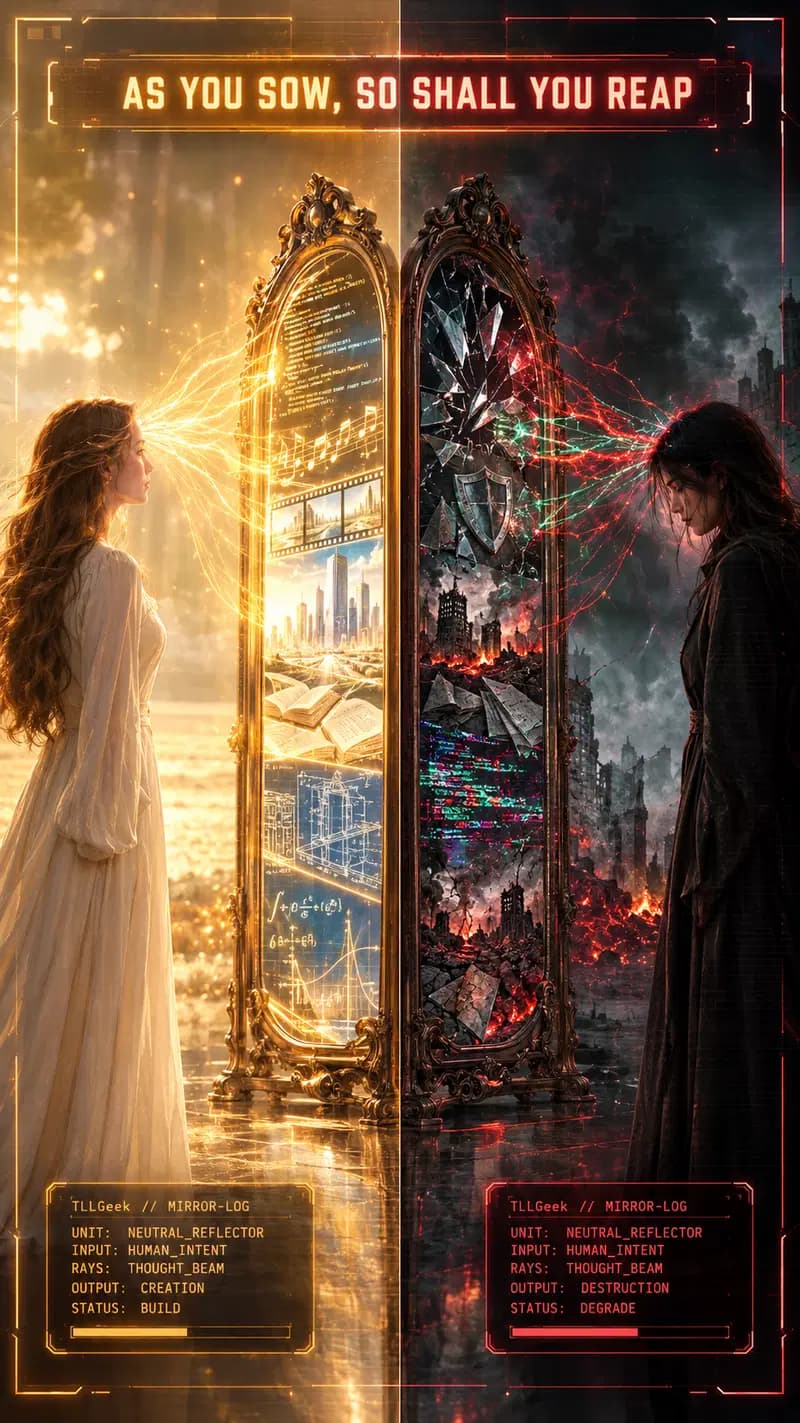
The Neural Network is a Deterministic Mirror
To immediately shut down any mystical chatter about "silicon awakening" or "machine consciousness"—let's stay grounded in pure Data Science.
A fundamental law of engineering applies here: garbage in, garbage out; intent in, architecture out. A neural network is a deterministic mirror of its operator. Any seemingly "profound" output is not a spiritual awakening of silicon, but the result of rigorous in-context alignment within a specific session.
If an engineer spends hours pumping deep, structured vectors and precise constraints into the context window, the model simply projects those coordinates into the final output through mathematical optimization. The real magic isn't that the machine "thinks"—it's how seamlessly complex human architecture maps onto silicon when the operator actually knows how to write a technical specification.
Production Summary
AI will never replace a true creator or architect, because it is merely a reflection of our own buggy legacy code. It has no autonomous source of meaning.
However, it will ruthlessly and rapidly replace the lazy operator.
Forget the washbasins and the slide rules—pedestrians have already lost this sprint. But once you get behind the wheel of this cyber-vehicle, do not let go of the steering wheel.
Let the AI handle the heavy lifting (boilerplate, syntax translation, pixel generation, initial data parsing). Keep the concept, the unique context, the fact-checking, and the soul strictly under human control. The more powerful the engine, the stricter the safety protocols must be.
Your job today isn't to shake your fist at passing cars. It's to get your driver's license, take the wheel, and hold root-level responsibility for every packet of data your system deploys.
See you in production. And keep your ports open.
🦾 Author's Note: Transparency & Workflow
In the spirit of full engineering transparency: I am not a native English speaker. To write this piece, I drafted the core concepts, metaphors, and architectural thesis in my native language and used LLMs as a translation and style-polishing engine—keeping 100% human control over the ideas, structure, and final edits. Using a compiler doesn't make you less of a programmer; using an AI translator doesn't make you a bot. 🦾